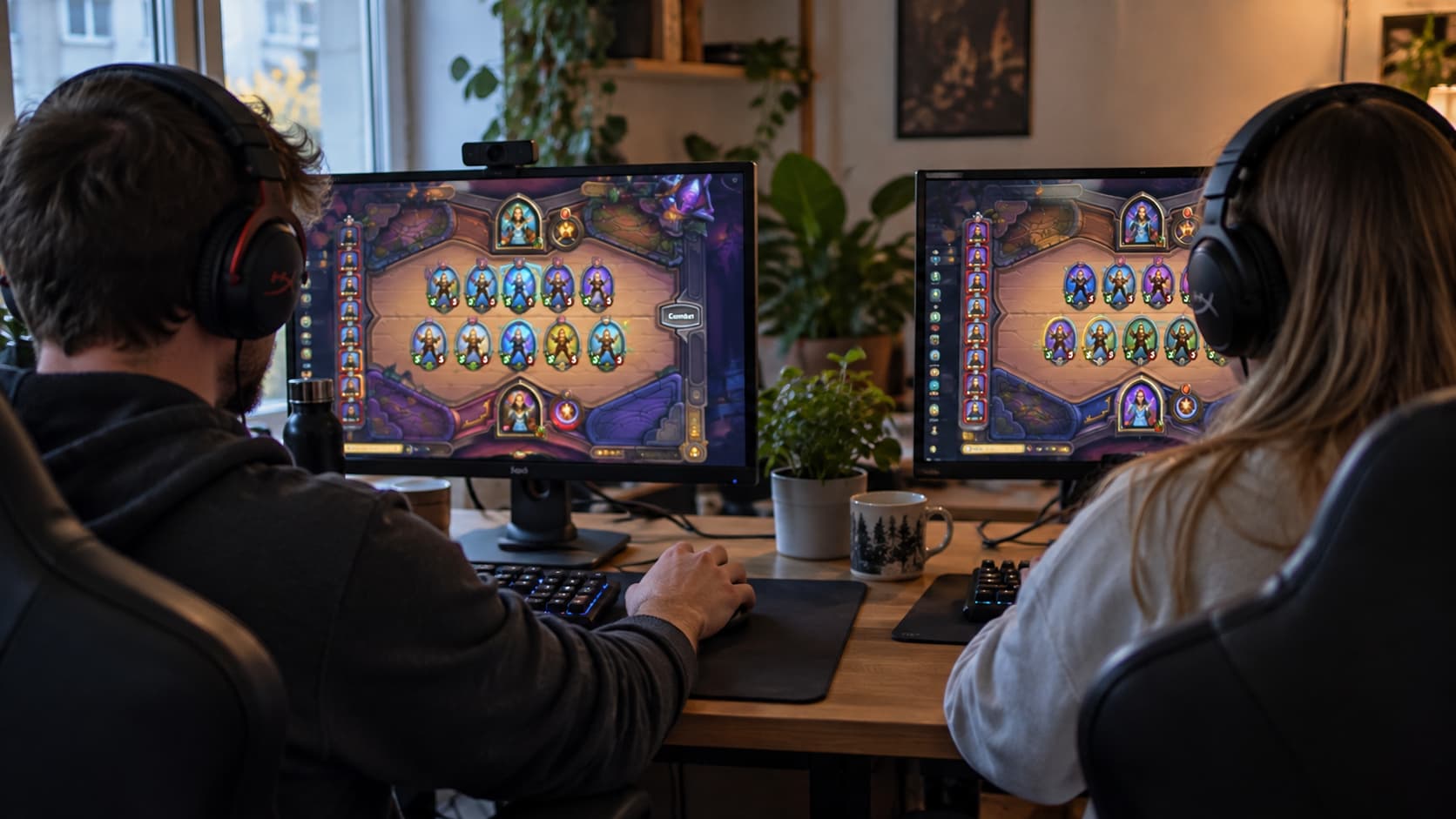
A powerful warband does not guarantee victory in Hearthstone Battlegrounds Duos. A player might assemble impressive minions, only to lose because their partner cannot survive the next combat. Another team with smaller individual boards may win by transferring a crucial card or coordinating their upgrades. These situations illustrate the central difference between Duos and traditional Battlegrounds: success depends on two players making decisions that benefit a shared position.
Introduced in April 2024, Duos remains a distinct competitive mode with its own rating system, cooperative mechanics and exclusive cards. Updates in 2026 have expanded the available interactions, but the underlying challenge remains consistent. Players must manage two separate warbands while treating their combined resources and survival prospects as a single strategic problem.
Two Warbands and One Health Pool
A Duos lobby contains four teams of two players. Each participant controls a separate hero, recruits minions and develops an individual warband. Teammates share Health and Armor, however, so damage affects both players equally. A weak board cannot be treated as somebody else’s problem when the entire team risks elimination.
Combat follows a sequential structure. One teammate’s warband fights first, and the other joins when necessary. If the opening warband defeats both opposing boards, the partner’s surviving minions can still contribute to the damage calculation. This makes board quality important for both participants, even when one player seems capable of defeating the enemy alone.
Hero selection introduces another dimension. Some heroes generate additional resources, while others specialize in building strong combat boards. A combination of complementary abilities can offer advantages that two individually powerful heroes might not achieve together. The exact interaction matters more than choosing characters solely because they perform well in solo Battlegrounds.
Players can inspect their partner’s board through the Portal during the recruitment phase. This feature should influence decisions from the opening turns. A teammate collecting a particular minion type may benefit more from a suitable shop discovery than someone pursuing an unrelated strategy. Recognizing that difference early reduces unnecessary competition for resources.
Passing Cards and Managing the Portal
The Portal is Duos’ defining strategic tool. Players can transfer cards from their hands to a teammate for 1 Gold per transfer. A purchased minion generally costs 3 Gold, meaning that buying and passing it requires 4 Gold altogether. That additional expense must produce a meaningful advantage.
Consider a partner holding two copies of the same minion. Finding the third copy could complete a Golden minion and provide a Triple Reward. Spending 4 Gold to purchase and transfer that card may be worthwhile if the resulting upgrade creates an immediate power increase or unlocks an important discovery.
The same transaction becomes less attractive when the recipient has no immediate use for the card. Sending an ordinary minion that occupies hand space without improving a composition sacrifices resources that might have strengthened the sender’s board. The best transfers solve specific problems rather than simply demonstrate cooperation.
There is another restriction worth remembering: ordinary Portal transfers work with cards in hand, not minions already placed on the battlefield. Playing a valuable minion immediately can therefore eliminate the opportunity to send it to a partner. Before committing a potentially useful card, check whether the other player needs it more.
Duos also includes cards that reward transferring resources. In the September 2026 update, Transport Reactor received stronger scaling tied to the number of cards a team had passed. Void Priest Cloner introduced another interaction by sending copies of discarded cards. An October balance update limited its effect to one plain copy per turn, demonstrating how quickly specific combinations can change.
These mechanics make passing part of deck-building strategy rather than a simple convenience. A team using transfer-related bonuses may justify exchanges that would otherwise be inefficient. Players should still evaluate whether those benefits outweigh the immediate Gold cost.
Building a Stronger Team Economy
Gold management becomes more demanding when two players can influence each other’s development. Every recruitment turn presents competing opportunities: buy minions, refresh the Tavern, use spells, upgrade Tavern Tiers or transfer cards. Spending efficiently requires understanding what both warbands need.
Duos also makes advanced Tavern upgrades more expensive than in solo Battlegrounds. Moving into Tiers 4, 5 and 6 carries an additional cost of 2 Gold at each level. Consequently, upgrading aggressively can leave a player temporarily vulnerable, particularly when the team has already lost substantial Health.
One useful approach is to divide responsibilities without making the arrangement permanent. A player with a strong early board may preserve combat stability while their partner invests in reaching higher Tavern Tiers. Once the developing player discovers powerful minions, the balance can shift. Both teammates should reassess their roles as the match progresses.
Suppose one player has several well-scaled lower-tier minions, while the other has identified a promising late-game composition. The first player might prioritize immediate board strength instead of spending heavily on Tavern upgrades. This gives the second player additional time to find essential pieces without exposing the team’s shared Health to unnecessary damage.
However, specialization can become a trap. If one player continually sends resources while neglecting their own warband, the team may eventually enter fights with only one effective board. Cooperation works best when both players maintain enough strength to contribute meaningfully.
Communication helps prevent these mistakes. The in-game ping system allows players to mark cards, hero powers and Tavern upgrades without using voice chat. A brief request for a particular minion or a signal to delay an upgrade can be more useful than repeated uncoordinated purchases.
Coordinating Combat and Avoiding Common Mistakes
The final stages of a Duos match demand attention to combat positioning. A minion with Taunt can redirect attacks, while Divine Shield, Reborn and Deathrattle effects influence how long a warband survives. Positioning these abilities correctly may determine whether a player defeats several enemy minions or loses their entire board prematurely.
The two teammates do not need identical compositions. One might focus on large, heavily buffed minions, while the other develops a board based on summons or Deathrattle effects. The important consideration is whether both contribute sufficient combat strength against the remaining opponents.
Recent Battlegrounds mechanics add further decisions. Aberrations, introduced in September 2026, use friendly minion deaths to awaken